
|
By Majella Clarke, Working Group 1 Assessing Institutional Commitment, Authority, and Attitudes Toward AI in Artistic Research Purpose of the FrameworkThis framework provides a structured method for mapping and analysing institutions within the cultural and creative sectors according to their relationship with artistic research and their attitudes toward the integration of artificial intelligence in artistic practice.
In addition to spatial positioning, institutions are represented using a black-to-white grayscale spectrum to visualise their attitude toward the adoption of AI in artistic work, ranging from institutionally negative or resistant positions to highly positive and proactive engagement. Image

Conceptual Structure of the Mapping Model The framework consists of a two-dimensional matrix with a third visual indicator: X-Axis: Institutional Authority within Artistic Research The horizontal axis measures the institution’s formal authority and structural capacity to shape artistic research environments. Authority reflects the degree to which an institution possesses the legal, administrative, and organisational ability to initiate, govern, and sustain artistic research activities. Authority is derived from governance powers and strategic influence to govern or influence the research system. Governance Indicators Key governance indicators include whether the institution:
Strategic Indicators Strategic authority concerns institutional influence over research agendas:
Institutions with extensive authority across these dimensions are positioned further to the right of the axis, indicating greater capacity to influence artistic research ecosystems and discourse. Those with limited or informal authority may be in such a situation if the institution is in the early stages of engaging with artistic researach or is positioned for local or informal contributions to aritstic research. Y-Axis: Institutional Commitment to Artistic Research The vertical axis measures the degree to which an institution actively cultivates, supports, and integrates artistic research into its educational, cultural, and societal roles. Commitment is the willingness to invest resources and sustain artistic research. Commitment reflects institutional investment in accessibility, participation, and the development of artistic research cultures. Accessibility and Inclusion Indicators Commitment may be assessed through indicators such as:
Financial Indicators Financial authority reflects the institution’s ability to sustain research structures:
Institutions demonstrating strong support for artistic research participation, resourcing, education, and dissemination are positioned higher on the vertical axis. Image

An additional tool that is an improtant catalyst in discussing an institutional position is the Attitude toward AI in artistic Work. This is potentially more complex and may need regular institutional discussion, and may be deliberately omitted from the framework or mapped to specific departments, depending on the institutional approach to AI in artisti practice. Dot Colour: Attitude Toward AI in Artistic Work Each institution is represented by a dot whose grayscale intensity indicates its position toward AI adoption in artistic research and creative practice.
The grayscale approach allows the map to visually express technological orientation without altering the structural positioning of institutions within the matrix. How to Use the Framework for Institutional Self AssessmentThe framework is designed as a reflective tool that allows institutions to analyse and position their own structures, capacities, and strategic orientation toward artistic research and AI adoption. The following steps outline a suggested process for conducting an institutional self-assessment. 1. Institutional Profile DefinitionBegin by defining the institutional unit to be assessed. This may include an entire organisation or a specific entity or deparmtnet within it, such as a faculty, research centre, laboratory, or artistic research unit. The framework can be applied to institutions operating across the cultural and creative sectors, including art universities, museums, cultural organisations, research institutes, policy bodies, or hybrid artistic-tech labs. 2. Evidence GatheringCollect relevant information that documents how artistic research is supported, governed, and implemented within the institution. Sources may include:
Both qualitative insights and quantitative indicators can be used to build a comprehensive picture of institutional structures and practices. 3. Axis AssessmentUsing the indicators defined in the framework, assess the institution’s position along the two primary dimensions:
The goal of this step is not to produce a precise numerical score, but rather to establish a reasoned institutional positioning based on available evidence. 4. Evaluation of Attitudes Toward AI in Artistic WorkReflect on the institution’s current orientation toward the use of artificial intelligence within artistic research and creative practice. Indicators may include:
This evaluation informs the grayscale shading applied to the institutional marker in the mapping. 5. Visual Positioning in the MatrixOnce the assessment has been completed, plot the institution within the matrix according to its evaluated level of authority and commitment. The institution’s marker is then shaded according to its attitude toward AI adoption, using the grayscale spectrum defined in the framework. As a comparative exercise, you could have the positioning against the same criteron indepednetly evaluated, which could be viewed as a more independent evaluation and positioning exercise that informs the institution’s strategy. This visual representation provides a concise overview of the institution’s current positioning within the broader artistic research ecosystem, and can be used to frame the question, if we are at this point now, where do we see ourselves in 5 years from now? And how might we get there? 6. Reflection and Strategic InterpretationThe final step involves interpreting the institutional position within the matrix. Institutions may use this reflection to:
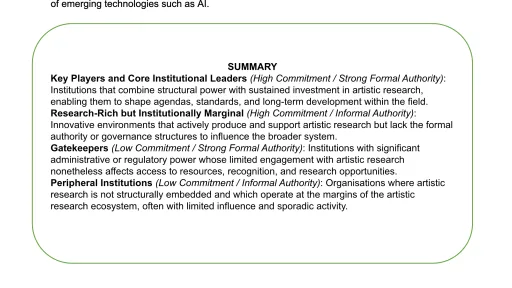
Used in this way, the mapping exercise supports strategic dialogue and institutional learning, rather than functioning as a ranking or benchmarking tool. Using, Analysing and Interpreting the ResultsOnce institutions have been positioned within the matrix according to their formal authority (X-axis) and commitment to artistic research (Y-axis), the resulting distribution can be interpreted through four quadrants. Each quadrant highlights distinct institutional roles within the artistic research ecosystem and can help identify structural dynamics, potential alliances, and areas for policy or institutional development. Key Players and Core Institutional Leaders: Institutions located in this quadrant combine substantial governance authority with sustained institutional investment in artistic research. These institutions often act as agenda-setters and infrastructural hubs within artistic research. They may host doctoral programmes, coordinate international research projects, maintain dedicated research infrastructure, and contribute to shaping sectoral policies and standards. Because of their structural influence and demonstrated commitment, institutions in this quadrant frequently serve as reference points for best practices, leadership, and long-term development in the field of artistic research. Image

Research-Rich but Institutionally Marginal: Institutions in this quadrant demonstrate strong engagement with artistic research practices but operate with limited formal authority within the broader artistic research system. They may produce innovative work, cultivate experimental research cultures, and support active artistic research communities, yet lack the governance structures or legal capacities required to fully influence institutional or policy frameworks. These organisations often function as sites of experimentation and innovation, generating new methodologies, practices, and interdisciplinary collaborations. However, they may be excluded from formal leadership roles due to structural factors such as limited degree-granting authority, restricted funding autonomy, or reduced visibility in national or international research governance structures. The presence of institutions in this quadrant highlights the importance of recognising and integrating innovative practices that emerge outside traditional centres of authority, and may indicate opportunities for collaboration or structural reform that better connect experimental research environments with formal research infrastructures. Image

Gatekeepers: Institutions positioned in this quadrant hold significant formal authority within artistic research systems but demonstrate limited institutional commitment to artistic research. These institutions often function as administrative or structural gatekeepers, influencing access to funding, research recognition, doctoral accreditation, or policy frameworks that affect the artistic research field. While their direct engagement with artistic research may be limited, their decisions can significantly shape the conditions under which artistic research operates. Mapping such institutions can therefore help identify structural barriers, governance bottlenecks, or strategic misalignments. Image
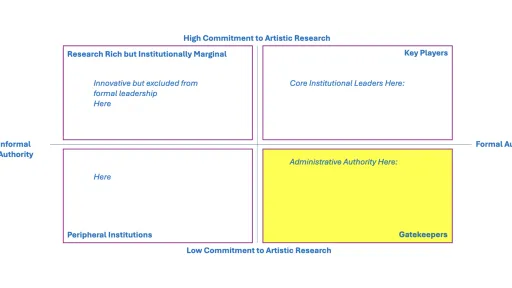
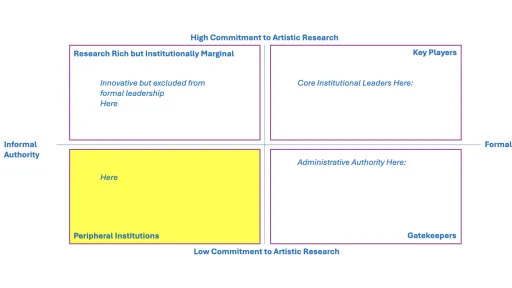
Peripheral Institutions: Institutions located in this quadrant operate with limited authority within the research system and relatively low institutional commitment to artistic research. Artistic research activities may occur sporadically or at an individual level, but are not embedded within institutional strategies, governance structures, or resource allocations. Their presence within the mapping remains important, as it can reveal broader patterns of uneven institutional engagement across the cultural and creative sectors. In some cases, institutions in this quadrant may represent emerging or transitional actors, where artistic research has not yet been fully recognised or structurally supported. Identifying such institutions can help highlight potential areas for capacity building, partnerships, or policy interventions aimed at strengthening research cultures. Image
In each of the quadrants, the user can also apply a greyscale to represent the AI attitudes within the institution, as outlined below. Image
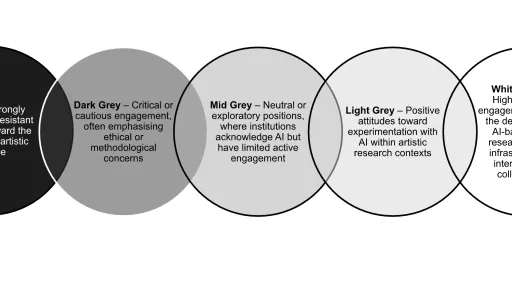
These AI attitudes may differ between individuals, and therefore it can help to either discuss and agree on a general average, or plot individual attitudes to see if clusters or patterns emerge from the exercise. These AI attitudes may also be dynamic and shift in a short period of time as new knowledge, methods and AI tools become available. Using the Quadrants for Analysis Interpreting the distribution of institutional entities or the position of an institution across these quadrants allows leadership, researchers and policymakers to better understand the structural dynamics of artistic research decision systems. The map may reveal concentrations of leadership, areas of innovation occurring outside formal authority structures, or gaps between governance power and research commitment. By analysing these relationships, the framework can help identify adaptation strategies, potential collaborations, and opportunities for strengthening the institutional foundations of artistic research, particularly in the context of ongoing digital transformation and the integration of emerging technologies such as AI. Image
Alignment with the COST Action MoU This framework directly contributes to the objectives of the COST Action by providing a systematic method for analysing relationships between artistic research institutions, technological change, and adaptation strategies. In line with the Memorendum of Understanding (MoU) emphasis on overcoming fragmented and isolated research practices, the mapping tool enables comparative analysis across institutions and sectors while making institutional positions and AI-technological attitudes more transparent. By situating organisations according to their commitment to artistic research, their influence within the research ecosystem, and their stance toward AI adoption, the framework supports the Action’s broader aim of identifying value propositions emerging from artistic research practices. The AI-institutional authroity and commitment framework contributes to the Working Group 1 objective of mapping adaptation strategies within the cultural and creative sectors in response to the digital shift, enabling stakeholders to identify transferable approaches and potential collaborations that enable responsible, accessible, and responsive uses of AI in artistic work. |
This work is based upon work from COST Action Artistic Intelligence — Responsiveness, Accessibility, Responsibility, Equity (ARTinRARE), CA23158, supported by COST (European Cooperation in Science and Technology).
COST (European Cooperation in Science and Technology) is a funding agency for research and innovation networks. Our Actions help connect research initiatives across Europe and enable scientists to grow their ideas by sharing them with their peers. This boosts their research, career and innovation.